Write what matters
Combine instruction and navigation context with visual relevance and within-frame diversity. Selected tokens update memory; all visual tokens remain available to the backbone.
Vision-and-language navigation
Memory that evolves as a robot navigates.
Retain what matters, beyond the visual context.
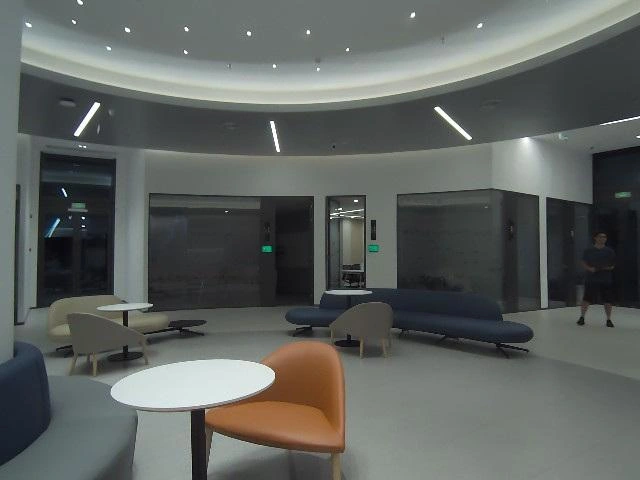 Egocentric observation
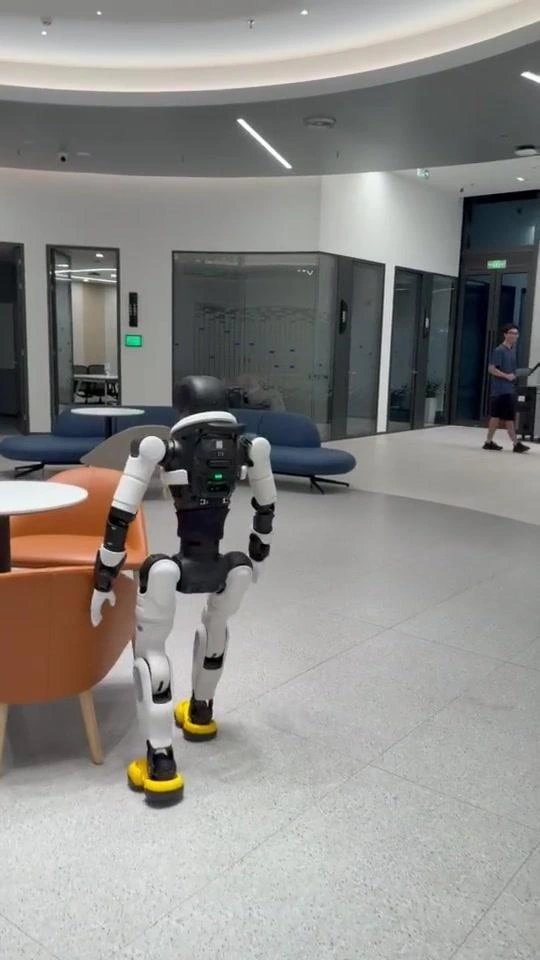 Real robot
“Return through the lounge, and stop beside the enclosure.”
Success rate R2R-CE Val-Unseen
Success rate RxR-CE Val-Unseen
Memory-augmented layers Independent episode-local fast weights
The idea
Navigation depends on what an agent has already seen. But only a limited number of observations fit in the model’s active visual context.
NavTTT stores selected historical evidence in Adaptive Parametric Memory (APM): small, episode-local fast weights that update as new observations arrive. The decoder can retrieve this experience later, even after the original frames leave its context.
Vision-and-language navigation (VLN) demands that agents accumulate and reason over streaming visual observations throughout long navigation episodes. Existing approaches struggle to maintain long-term history, constrained by the finite context capacity of transformer architectures. To solve the problem, fast-weight test-time training (TTT) provides a mechanism for encoding streaming observations into an evolving parameter state. However, existing TTT does not distinguish informative observations from repetitive visual content, allowing redundant tokens to interfere with the retention of information needed for subsequent decisions.
We propose Navigation-Conditioned Test-Time Training (NavTTT), which introduces adaptive memory formation and hierarchical memory integration for vision-and-language navigation. NavTTT leverages global navigation context to prioritize informative visual evidence and integrates language instructions with spatial information to construct spatially grounded memory representations. Episode-local nonlinear fast weights store these representations as Adaptive Parametric Memory (APM), preserving history beyond the visual context for later decisions.
To reduce cross-layer coupling in memory formation, NavTTT maintains independent fast-weight memories across multiple decoder depths. This decoupled design prevents errors or biases from spreading across different memory levels. Meanwhile, it enables shared historical information to be independently represented at various levels of abstraction. Experiments demonstrate strong navigation performance on VLN-CE benchmarks and effective instruction following on a real robot.
How it works
Navigation-conditioned writing and independent memories at multiple decoder depths connect past experience with the next action.
Combine instruction and navigation context with visual relevance and within-frame diversity. Selected tokens update memory; all visual tokens remain available to the backbone.
Encode appearance together with spatial cues and navigation state. Independent nonlinear fast weights store these associations locally within each episode.
Six APM branches, each with four memory heads, complement self-attention throughout the decoder. Each layer queries its own representation of accumulated history.
The current action chunk reads the previous fast-weight state. New evidence is committed after action generation, becoming available at the following decision. The pretrained backbone stays fixed during inference.
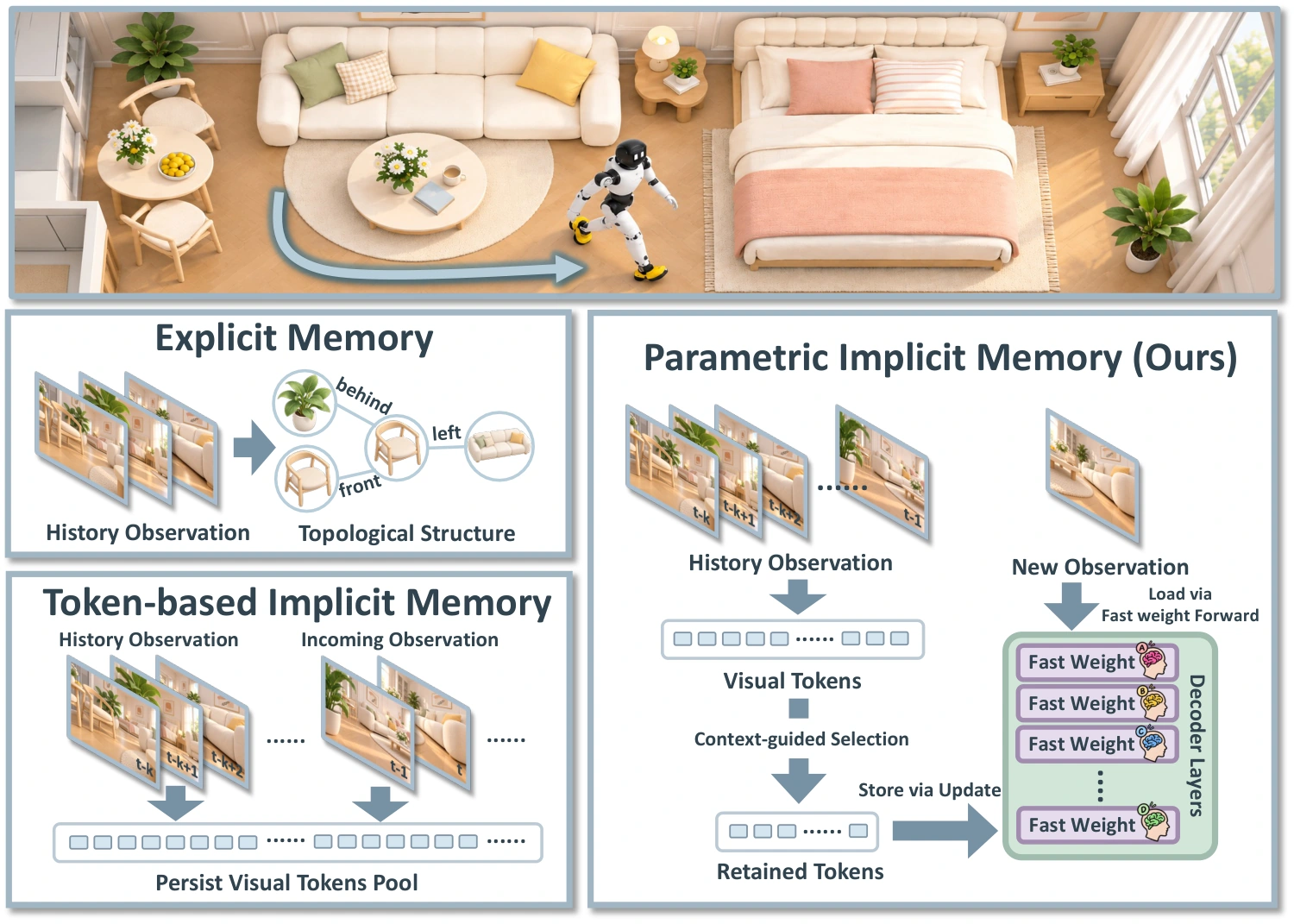
Explicit memory retains maps or graphs. Token-based implicit memory carries visual representations forward. NavTTT internalizes selected history through online fast-weight updates, then retrieves it with layer-specific queries.
Experiments
Reported results on the R2R-CE and RxR-CE Val-Unseen splits. Choose a benchmark and metric to explore the comparison.
R2R-CE Val-Unseen · higher is better
Selected comparisons from the manuscript. NavTTT uses RGB and pose; the listed baselines use a single RGB stream. Training data and configurations differ. NE is in meters; other metrics are percentages. Missing results are shown as “—”.
A closer look
Architectural controls evaluated under matched training protocols within each backbone.
Bold indicates the best value in the selected backbone and benchmark. The complete model does not lead every individual metric.
Beyond simulation
A humanoid robot follows natural-language instructions using streaming RGB observations. Inference runs off-board on an RTX 4090, with no real-world trajectory fine-tuning.
Successful real-world trials
27.5% success rate@misc{luo2026navttt,
title = {{NavTTT}: Adaptive Parametric Memory via
Hierarchical Test-Time Training for
Vision-and-Language Navigation},
author = {Luo, Xiaoyu and Lin, Chengxing and
Huang, Jiaxin and Liu, Jiale and Guo, Jingyu and
Chen, Sirui and Li, Aolin and Huang, Shaoli and
Xu, Cheng-zhong and Kong, Hui},
year = {2026},
eprint = {2611.27219},
archivePrefix = {arXiv},
primaryClass = {cs.RO},
url = {https://arxiv.org/abs/2611.27219}
}